
The Best Chocolate Chip Cookies Recipe Ships Faster Than Your Last Product Launch
A cookie either holds its shape, tastes right, and gets made again next week, or it dies in the pan the way most side projects die in a backlog — and the best chocolate chip cookies recipe treats every variable the way a founder treats a metric: measured, tested, and cut the moment it stops earning its place.
Why Most Recipes Fail the Way Most MVPs Fail
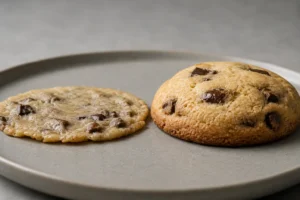
Most chocolate chip cookie recipes online read like a pitch deck built for investors instead of users: long, vague, and padded with steps that exist to look thorough rather than to produce a result. They call for “room temperature butter” without a temperature, “a pinch of salt” without a gram measurement, and “bake until golden” without a time range. That’s not a recipe; that’s a placeholder for one.
The best chocolate chip cookies recipe removes every unmeasured variable, the same way a good engineering team removes every untested assumption before a release. Here’s the version that survives real kitchens, not just photo shoots:
Ingredients (makes 24 cookies):
- 226g unsalted butter, browned and cooled to 24°C
- 200g dark brown sugar
- 100g granulated sugar
- 2 large eggs, plus 1 egg yolk
- 10g vanilla extract
- 340g all-purpose flour
- 6g baking soda
- 6g fine sea salt
- 340g chocolate chips or chopped chocolate bar (60% cacao)
Method:
- Brown the butter in a light-colored pan over medium heat until it smells nutty and shows flecks of brown solids, roughly 6 minutes. Cool it to 24°C before use — skip this step and every downstream measurement drifts, exactly like skipping a code review drifts a codebase.
- Whisk the browned butter with both sugars for 2 minutes until the mixture looks glossy.
- Add the eggs, yolk, and vanilla. Whisk for another 90 seconds.
- Fold in flour, baking soda, and salt until just combined. Overmixing builds gluten and turns a cookie into a hockey puck.
- Fold in the chocolate.
- Chill the dough for at least 24 hours, portioned into 60g balls.
- Bake at 190°C for 11 minutes, rotating the tray at the 6-minute mark.
Every gram, every degree, every minute in that method exists because it changes the outcome. That discipline is what separates the best chocolate chip cookies recipe from the hundred variations sitting one search result above and below it.
The ROI Math: Why 24-Hour Chilled Dough Beats “Bake Immediately”
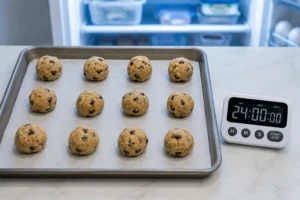
Founders don’t chase activity; they chase return. Apply that lens to cookie dough and the 24-hour chill isn’t a nice-to-have — it’s the single highest-leverage step in the entire process.
Unchilled dough spreads fast in the oven because the butter is still soft and the flour hasn’t finished hydrating. The result: thin, greasy, uniform discs with a texture close to a store-bought wafer. Chilled dough behaves differently for three measurable reasons:
- Butter solidifies, so the cookie holds its shape longer in the oven before spreading, giving you a thicker center and a crisp edge.
- Flour fully hydrates, which deepens flavor and produces a chewier crumb — the same effect aging has on a good steak or a cured meat.
- Sugars have time to partially dissolve into the fat and egg mixture, which caramelizes more evenly during baking and produces a deeper color without burning the edges.
Run the comparison yourself: bake half a batch fresh and chill the other half for a day. The chilled batch will consistently score higher on texture, color, and flavor in a blind taste test — the same kind of A/B test a growth team runs before shipping a pricing change. The best chocolate chip cookies recipe isn’t guessing at this tradeoff; it’s built around it.
Four Variables That Actually Move the Outcome
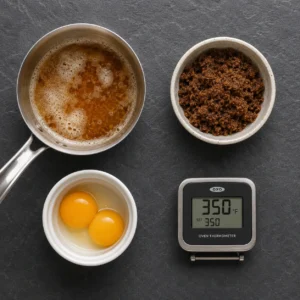
Cut everything else out of a cookie recipe and four variables remain that meaningfully change the result. Everything else is noise.
- Brown butter vs. melted butter. Browning the butter adds a nutty, caramel-forward flavor compound (Maillard reaction byproducts) that melted butter never develops. This single swap does more for flavor than any extract, spice, or add-in.
- Brown sugar ratio. A higher ratio of brown sugar to granulated sugar increases moisture retention (molasses is hygroscopic) and produces a chewier cookie. Drop the brown sugar ratio and the cookie turns crisp and dry within two days of baking.
- Egg yolk count. An extra yolk adds fat and emulsifiers without adding the water content of a whole egg, which produces a denser, fudgier center. This is a one-ingredient lever with an outsized payoff, similar to how a single well-placed feature flag can change an entire user funnel.
- Oven temperature accuracy. Most home ovens run 10-15°C off their dial setting. An oven thermometer costs less than a coffee order and removes the single biggest source of failed batches — cookies that are burnt on the bottom and raw in the middle because the “180°C” setting is actually running at 195°C.
Optimize these four levers and the rest of the recipe — chocolate brand, mixer speed, tray material — becomes a rounding error. This is the same principle behind cutting a product roadmap down to the two features that move retention instead of the twenty that move a demo.
Shipping the Recipe: What Actually Breaks in Practice
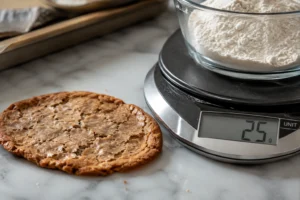
Recipes fail in execution far more often than they fail on paper, and the fixes are specific enough to apply immediately.
- Cookies spread too thin: the dough wasn’t cold enough, or the butter was warmer than 24°C when mixed. Chill the dough longer, not the tray.
- Cookies taste flat: the salt measurement was eyeballed instead of weighed. Salt is a flavor amplifier, not a seasoning; fine sea salt at 6g per batch is the tested minimum for balancing 340g of sugar.
- Centers stay raw: the tray came straight from the fridge into a cold oven. Preheat fully — 15 minutes minimum — before the tray goes in.
- Batches vary week to week: ingredients were measured by volume (cups) instead of weight (grams). A cup of flour can weigh anywhere from 120g to 150g depending on how it’s scooped; a kitchen scale removes that variance entirely.
- Chocolate pools instead of holding shape: chocolate chips are formulated with stabilizers to hold their shape in the oven; a chopped chocolate bar melts more but tastes better. Pick one based on whether appearance or flavor matters more for the occasion, and don’t mix expectations.
None of these fixes require a new ingredient or a new technique — they require weighing what’s currently being eyeballed, which is the same lesson that shows up in every postmortem about a metric nobody was tracking until it broke.
The best chocolate chip cookies recipe survives repeated batches, converts skeptics on the first bite, and costs less than ten dollars to produce two dozen times over. Weigh the ingredients, chill the dough, trust the thermometer, and the outcome repeats itself every time.
Written by Choweats.com
Resources
- cookie chemistry behind chewy vs. crisp texturehttps://www.kingarthurbaking.com/blog/2016/12/21/cookie-science
- why butter outperforms shortening and oil in cookieshttps://www.kingarthurbaking.com/blog/2023/03/31/butter-oil-shortening-which-fat-makes-the-best-chocolate-chip-cookies