
Why Fresh Cookies and Brownies Beat Every Other Office Perk You’ve Budgeted For
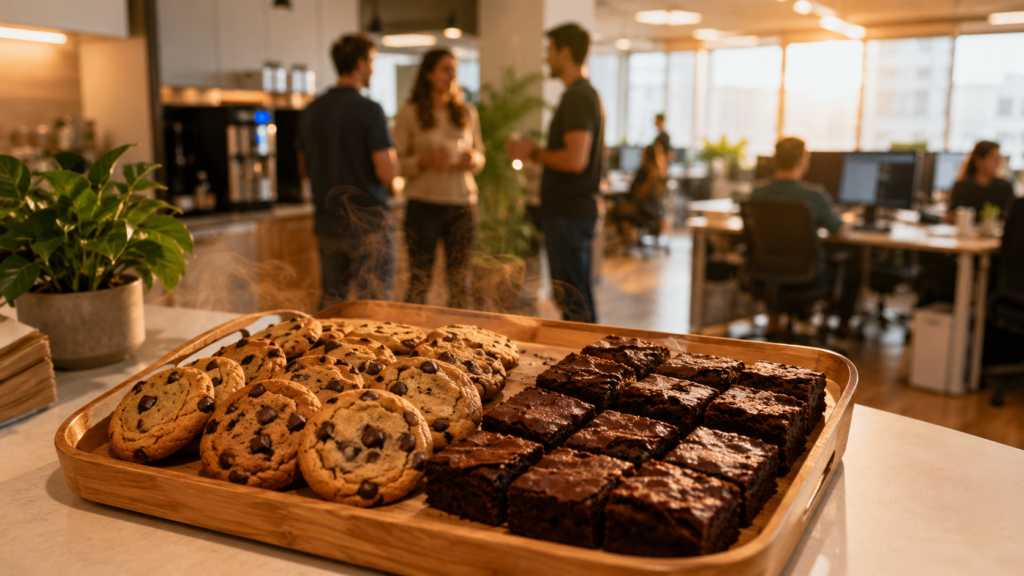
Your engineering team ships faster when the kitchen smells like fresh cookies and brownies, and that’s not a metaphor — it’s a measurable shift in how people move through the office.
Fresh Cookies and Brownies Cost Less Than the Perks You Already Pay For
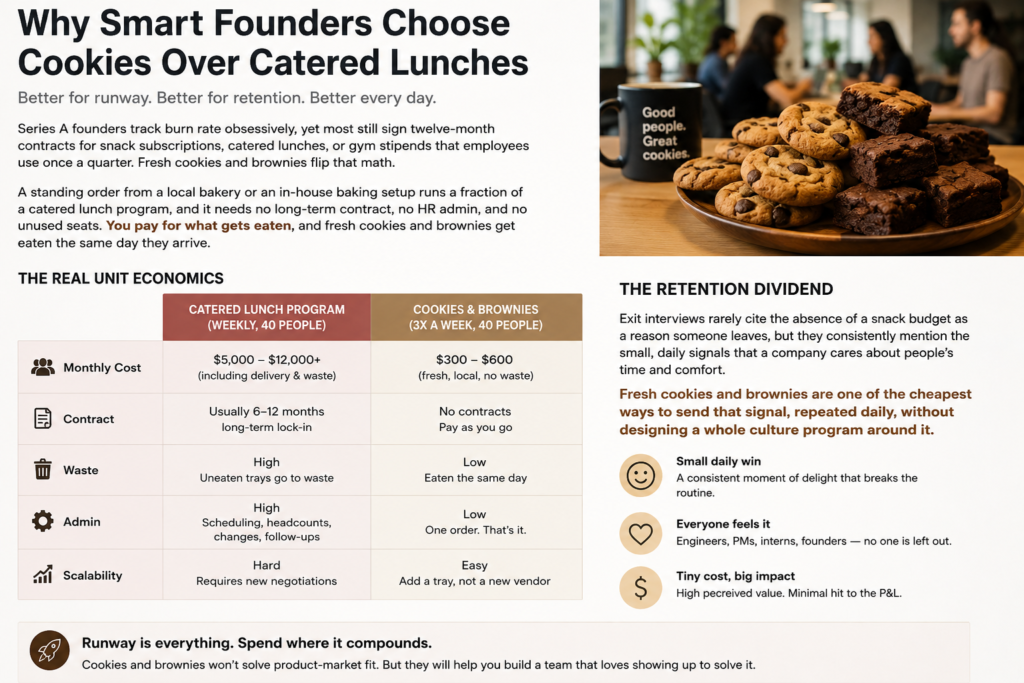
Series A founders track burn rate obsessively, yet most still sign twelve-month contracts for snack subscriptions, catered lunches, or gym stipends that employees use once a quarter. Fresh cookies and brownies flip that math. A standing order from a local bakery or an in-house baking setup runs a fraction of a catered lunch program, and it needs no long-term contract, no HR admin, and no unused seats. You pay for what gets eaten, and fresh cookies and brownies get eaten the same day they arrive.
Compare the unit economics directly. A weekly catered lunch program for a 40-person team commonly runs into five figures a month once you include delivery fees and waste from unpicked trays. Fresh cookies and brownies delivered three times a week, by contrast, typically cost a few hundred dollars monthly and scale linearly with headcount — you add a tray, not a new vendor negotiation. For a founder watching runway, that’s the difference between a perk you can kill in a bad quarter and one that barely shows up on the P&L.
There’s also a retention angle that founders underweight. Exit interviews rarely cite the absence of a snack budget as a reason someone leaves, but they consistently mention the small, daily signals that a company cares about people’s time and comfort. Fresh cookies and brownies are one of the cheapest ways to send that signal, repeated daily, without designing a whole culture program around it.
Fresh Cookies and Brownies Create the Hallway Conversations Slack Can’t
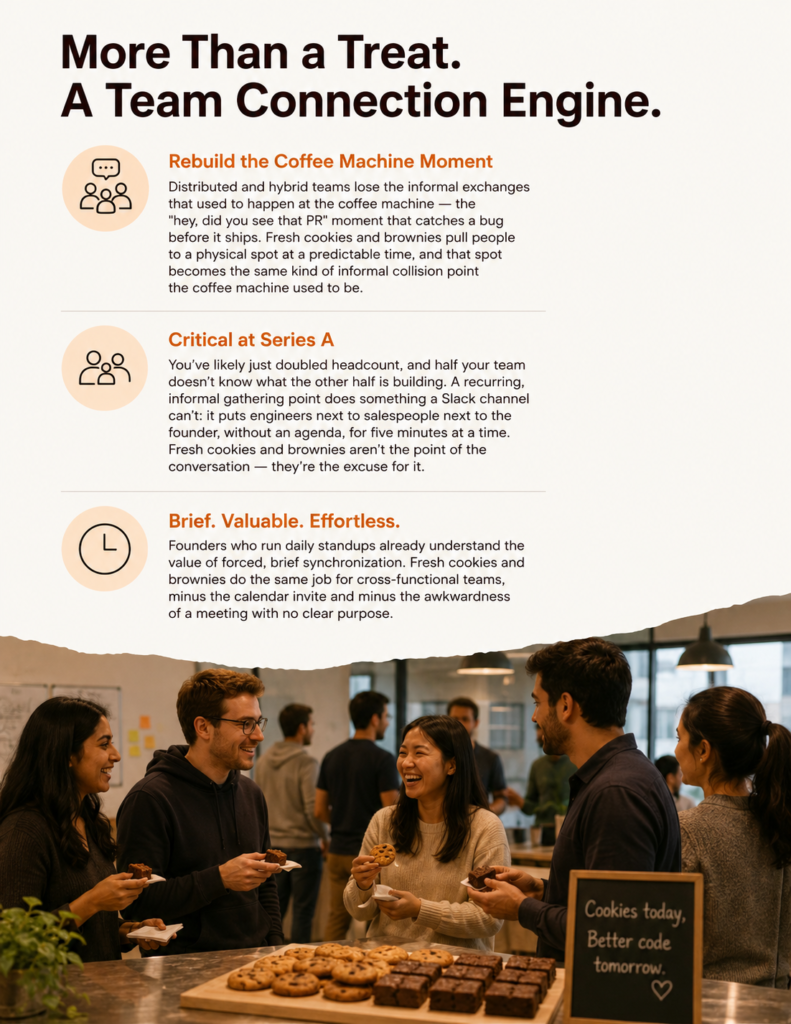
Distributed and hybrid teams lose the informal exchanges that used to happen at the coffee machine — the “hey, did you see that PR” moment that catches a bug before it ships. Fresh cookies and brownies pull people to a physical spot at a predictable time, and that spot becomes the same kind of informal collision point the coffee machine used to be.
This matters more at Series A than at any other stage. You’ve likely just doubled headcount, and half your team doesn’t know what the other half is building. A recurring, informal gathering point does something a Slack channel can’t: it puts engineers next to salespeople next to the founder, without an agenda, for five minutes at a time. Fresh cookies and brownies aren’t the point of the conversation — they’re the excuse for it.
Founders who run daily standups already understand the value of forced, brief synchronization. Fresh cookies and brownies do the same job for cross-functional teams, minus the calendar invite and minus the awkwardness of a meeting with no clear purpose.
Fresh Cookies and Brownies Signal Momentum to Candidates and Investors
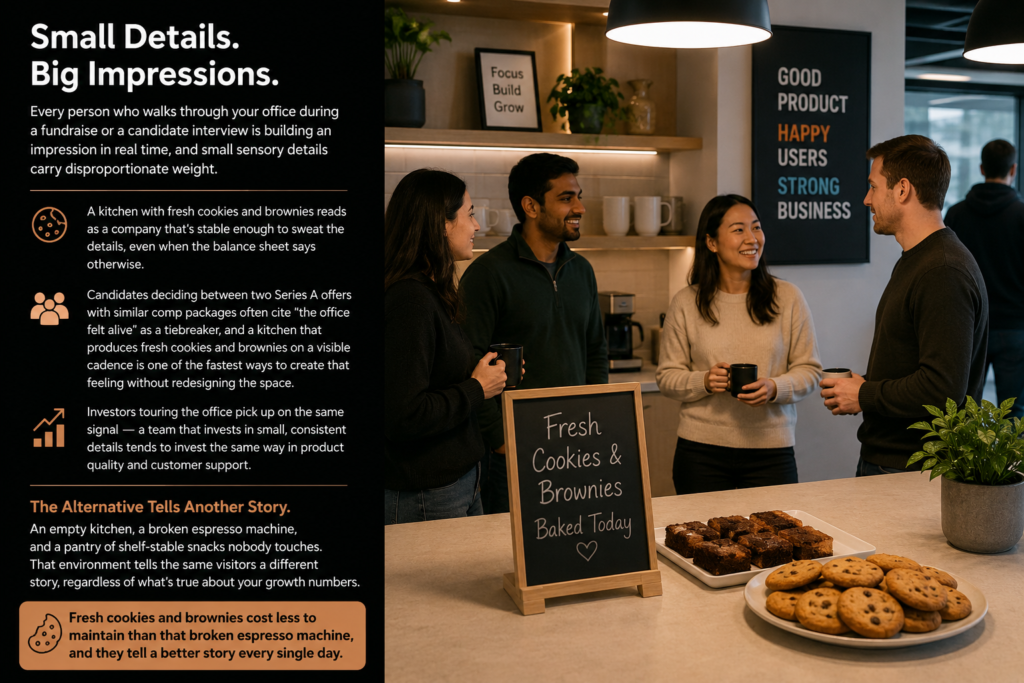
Every person who walks through your office during a fundraise or a candidate interview is building an impression in real time, and small sensory details carry disproportionate weight. A kitchen with fresh cookies and brownies reads as a company that’s stable enough to sweat the details, even when the balance sheet says otherwise.
This isn’t about vanity. Candidates deciding between two Series A offers with similar comp packages often cite “the office felt alive” as a tiebreaker, and a kitchen that produces fresh cookies and brownies on a visible cadence is one of the fastest ways to create that feeling without redesigning the space. Investors touring the office pick up on the same signal — a team that invests in small, consistent details tends to invest the same way in product quality and customer support.
Contrast this with the alternative: an empty kitchen, a broken espresso machine, and a pantry of shelf-stable snacks nobody touches. That environment tells the same visitors a different story, regardless of what’s true about your growth numbers. Fresh cookies and brownies cost less to maintain than that broken espresso machine, and they tell a better story every single day.
Fresh Cookies and Brownies Scale With You Instead of Against You
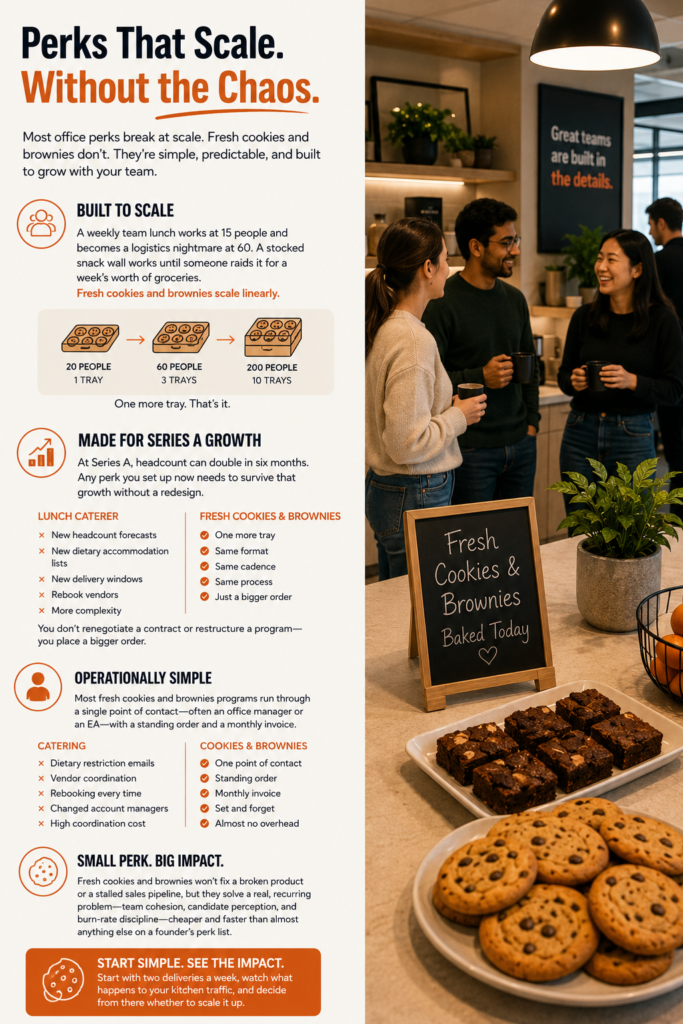
Most office perks break at scale. A weekly team lunch works at 15 people and becomes a logistics nightmare at 60. A stocked snack wall works until someone raids it for a week’s worth of groceries. Fresh cookies and brownies scale differently because the unit of delivery — a tray, a dozen, a box — scales linearly with headcount, and the format doesn’t change whether you’re serving 20 people or 200.
This matters specifically at Series A, where headcount can double in six months and any perk you set up now needs to survive that growth without a redesign. A lunch caterer needs new headcount forecasts, new dietary accommodation lists, and new delivery windows every time the team grows. Fresh cookies and brownies need one more tray. You don’t renegotiate a contract or restructure a program — you place a bigger order.
The operational simplicity extends to who manages it. Most fresh cookies and brownies programs run through a single point of contact — often an office manager or an EA — with a standing order and a monthly invoice. Compare that to the coordination overhead of catering, where someone fields dietary restriction emails and rebooks vendors every time a account manager changes. At a stage where every operational hour matters, fresh cookies and brownies ask for almost none of it.
Fresh cookies and brownies won’t fix a broken product or a stalled sales pipeline, but they solve a real, recurring problem — team cohesion, candidate perception, and burn-rate discipline — cheaper and faster than almost anything else on a founder’s perk list. Start with two deliveries a week, watch what happens to your kitchen traffic, and decide from there whether to scale it up.