
Conversion Rate Optimization Is the Cheapest Growth Lever a Series A Founder Isn’t Pulling
A founder who spends another $50,000 on paid acquisition before fixing a broken signup flow is pouring water into a bucket with a hole in it, and conversion rate optimization is the patch that costs a fraction of that spend.
Why Conversion Rate Optimization Beats Acquisition Spend on Pure ROI
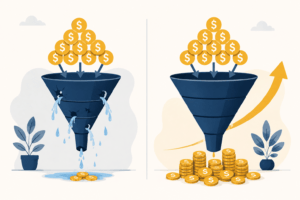
Founders chase new traffic first because it feels like growth, but conversion rate optimization improves the output of traffic you’re already paying for, which makes it the higher-margin lever in almost every case. If a company spends $30,000 a month on paid acquisition and converts 2% of visitors, doubling that conversion rate to 4% doubles revenue from the exact same ad spend — no new customer acquisition cost, no new campaign risk, just a better-performing funnel processing traffic the company already bought.
Compare the two paths directly. Acquisition spend carries diminishing returns as a founder exhausts the cheapest channels and moves into more expensive, less-targeted traffic sources. Conversion rate optimization carries the opposite curve early on: the first few fixes — a confusing signup form, a slow-loading pricing page, unclear value proposition copy — often produce the largest gains relative to effort, since most early-stage sites accumulate friction nobody has audited yet.
Baymard Institute’s ongoing checkout usability research, based on testing hundreds of e-commerce and SaaS signup flows, has found that unnecessary form fields and unclear error messaging rank among the most common friction points causing users to abandon a flow before completing it. A founder running conversion rate optimization as a standing practice catches these friction points through direct user testing and session recordings instead of guessing at what’s broken from an analytics dashboard alone.
The cost asymmetry matters most to a Series A founder guarding runway. A single round of conversion rate optimization — running session recordings through a tool like Hotjar or FullStory, interviewing five to ten users about where they got stuck, and shipping the top three fixes — costs a few thousand dollars and one or two engineering sprints. Acquiring the equivalent revenue lift through new paid traffic, at typical Series A customer acquisition costs, would cost many multiples of that same investment with none of the compounding benefit, since a fixed funnel keeps converting better on every future visitor, paid or organic.
Real Companies, Real Lifts: What Conversion Rate Optimization Has Actually Delivered
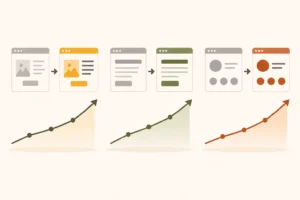
Founders trust specific, documented outcomes over general claims, and conversion rate optimization has a long track record of publicly documented wins worth studying directly. The Obama 2008 campaign’s digital team, working with optimization consultant Dan Siroker, ran a widely cited test on their donation signup page comparing different button text and media combinations, and the winning combination reportedly increased signup conversion by a large margin over the original — a result credited with generating millions of additional email signups and donations during the campaign, a case study Siroker later wrote about publicly after co-founding the A/B testing platform Optimizely.
HubSpot has published its own internal conversion rate optimization case studies over the years, including tests on landing page structure, form length, and call-to-action placement, consistently finding that removing unnecessary form fields and clarifying value propositions above the fold produced measurable lifts in lead conversion rates across multiple campaigns. The pattern HubSpot’s own research repeatedly surfaces — shorter forms and clearer above-the-fold messaging outperforming longer forms and vague headlines — gives a Series A founder a low-risk starting hypothesis to test on their own signup or demo-request flow before running a single custom experiment.
Basecamp’s public writing on their own marketing site redesigns describes deliberately simplifying their signup flow and pricing page copy over multiple iterations, treating the site itself as a product to be refined rather than a static asset, a philosophy consistent with treating conversion rate optimization as an ongoing practice rather than a one-time project.
The common thread across these examples isn’t a specific button color or headline — it’s the discipline of testing an actual hypothesis against real user behavior instead of redesigning based on internal opinion. A Series A founder doesn’t need Obama-campaign traffic volume to benefit from conversion rate optimization; even smaller-traffic B2B SaaS sites can run qualitative research — user interviews, session recordings, heatmaps — to find and fix friction without needing statistical significance from a formal A/B test.
Where to Start: The Highest-Leverage Conversion Rate Optimization Targets for a Lean Team
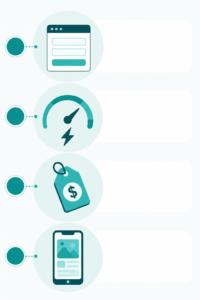
A Series A team without a dedicated growth hire needs to prioritize conversion rate optimization efforts against limited engineering time, and not every page or step in the funnel deserves equal attention. The signup or demo-request form is almost always the highest-leverage starting point, since it sits at the exact moment a visitor has decided they’re interested and friction here directly blocks revenue that’s already been earned through marketing and sales spend.
Nielsen Norman Group’s usability research has repeatedly found that reducing form length and clarifying required versus optional fields reduces abandonment, and that unclear error messages — a field turning red with no explanation of what’s wrong — cause users to give up rather than troubleshoot. A founder auditing their own signup form should count the fields, cut anything not strictly necessary for account creation, and test every error state manually before assuming conversion rate optimization requires a bigger initiative than it does.
Page load speed deserves equal priority, since it affects every page in the funnel simultaneously rather than one isolated step. Google’s own research on page speed and conversion, published through their web.dev platform, has found that as page load time increases past a few seconds, bounce rate climbs sharply, meaning a slow pricing or signup page actively works against every dollar spent driving traffic to it. Conversion rate optimization work here often means compressing images, deferring non-critical scripts, and cutting unnecessary third-party tracking tags rather than a full rebuild.
Pricing page clarity ranks as the third highest-leverage target for a B2B SaaS company specifically, since a confusing pricing structure creates hesitation at the exact moment a visitor is closest to becoming a paying customer. ProfitWell’s pricing research, drawn from work with hundreds of SaaS companies, has found that unclear plan differentiation and hidden or unclear pricing consistently correlate with lower conversion from visitor to trial or purchase, reinforcing that clarity — not necessarily lower prices — drives the biggest conversion rate optimization gains on this specific page.
Mobile experience rounds out the priority list, since a growing share of B2B research and even signup activity happens on mobile despite most SaaS products being used on desktop. A founder should manually walk through their own signup flow on a phone at least once a quarter; conversion rate optimization efforts frequently uncover forms with broken mobile layouts or buttons sized for a mouse cursor rather than a thumb, friction that never shows up when a founder only tests on their own laptop.
Running Conversion Rate Optimization Without a Dedicated Growth Team

A lean Series A team can run conversion rate optimization effectively without hiring a dedicated growth or CRO specialist, provided the founder treats it as a recurring process rather than a one-time redesign project. Start with qualitative research before any A/B test: five user interviews or session-recording reviews typically surface the same two or three friction points independently, giving a founder confidence about what to fix first without needing a large testing budget.
Formal A/B testing requires meaningful traffic volume to reach statistical significance, and most Series A companies don’t have enough monthly signups to run a rigorous split test on subtle copy changes. Conversion rate optimization at this stage should lean on qualitative signals and larger, more obviously impactful changes — cutting form fields in half, rewriting a confusing headline, fixing a broken mobile layout — rather than testing minor variations that would take months to reach significance at low traffic volumes.
Tooling stays cheap at this stage. Free or low-cost tools like Google Analytics for funnel drop-off data, Hotjar’s free tier for session recordings and heatmaps, and simple user-interview scheduling through Calendly cover the full research stack a founder needs before writing a single line of new code. Conversion rate optimization doesn’t require an enterprise testing platform until a company has the traffic volume to justify one, typically well past Series A.
Assign clear ownership even on a lean team. A founder or a single product manager should own the conversion rate optimization backlog the same way engineering owns a sprint backlog — a prioritized list of hypotheses, ranked by expected impact and effort, reviewed on a fixed monthly cadence. Without this ownership, conversion improvements happen sporadically whenever someone notices a problem rather than through a deliberate, compounding process.
Conversion rate optimization isn’t a specialist’s side project — it’s the fastest, cheapest lever a Series A founder has to turn existing traffic into existing revenue without spending another dollar on acquisition. Audit the signup flow this week, fix the biggest friction point you find, and let the next cohort’s numbers prove the case.
Written by Choweats.com