
Why Every Series A Founder Needs a Real Gym Workout Plan, Not Random Reps
A founder who trains without a gym workout plan burns the same hours a founder with a plan burns, except one of them walks out stronger every month and the other walks out guessing.
The ROI Case: A Gym Workout Plan Protects the Asset That Runs Your Company

Investors bet on your judgment, your energy, and your ability to make clear decisions under pressure for years at a stretch, and all three of those degrade fast when sleep, stress, and physical capacity go unmanaged. A structured gym workout plan is the cheapest insurance policy a founder can buy against burnout, because it forces recovery windows, predictable time blocks, and measurable progress into a schedule that otherwise runs on adrenaline and back-to-back calls.
Compare the two paths directly. A founder who walks into the gym without a gym workout plan spends the first ten minutes deciding what to train, defaults to whatever machine is open, and leaves without knowing whether this session moved them closer to any goal. A founder running a structured gym workout plan walks in, executes a pre-decided sequence, and leaves in the same sixty minutes with a logged number that tells them exactly what to beat next time. Decision fatigue costs real cognitive bandwidth, and a founder who eliminates workout decisions preserves that bandwidth for product and hiring calls instead.
The time cost argument matters most to a Series A founder guarding every hour of runway. Three structured sessions a week, forty-five to sixty minutes each, deliver more strength and cardiovascular improvement than five unstructured sessions of wandering between machines, according to strength and conditioning research published through the National Strength and Conditioning Association, which consistently links progressive overload and session structure to measurable strength gains over unstructured training volume. A gym workout plan built around three focused sessions costs less weekly time than most founders currently spend on unproductive gym visits, while producing results those visits never delivered.
Physical capacity also compounds the same way product velocity does. A founder who can sit through six hours of investor meetings without a mid-afternoon energy crash, or who can handle a cross-country flight and still run a sharp all-hands the next morning, is running on a body a gym workout plan built over months, not a body that got lucky on a given week.
Speed to Results: What a Gym Workout Plan Delivers in the First 90 Days

Founders judge everything by time-to-signal, and a gym workout plan built on compound movements produces visible signal faster than any scattered approach. Compound lifts — squats, deadlifts, presses, and rows — recruit multiple muscle groups per movement, which means a founder training three days a week on a compound-focused gym workout plan sees strength jump on the bar within the first four to six weeks, a pattern well documented in beginner strength-training literature from exercise physiologists like Dr. Brad Schoenfeld, whose published research on hypertrophy and strength adaptation shows novice lifters respond fastest to compound, progressive-overload programming.
A real example from the startup world: Basecamp co-founder Jason Fried has spoken publicly about structuring his own workday around consistent, non-negotiable training blocks, treating physical training with the same scheduling discipline he applies to shipping software — a gym workout plan gets the same calendar priority as a client call, not the leftover slot after everything else gets scheduled.
The first 90 days on a structured gym workout plan follow a predictable arc: weeks one through four build movement pattern competency and light strength gains, weeks five through eight show measurable increases in the main lifts as the nervous system adapts, and weeks nine through twelve show the first visible body composition changes alongside continued strength progress. A founder who tracks this arc on paper or in an app sees the proof in numbers instead of relying on how a mirror makes them feel on a stressful day.
Speed also comes from cutting the wrong kind of variety. Founders who chase workout trends — a new class, a new influencer program, a new machine circuit every week — reset their adaptation curve constantly and never let any single stimulus compound. A gym workout plan that repeats the same core lifts for eight to twelve weeks before changing variables lets the body adapt in a straight line instead of a zigzag, which is the same principle a founder already applies to product iteration: change one variable at a time and measure the result before changing the next one.
Building the Actual Gym Workout Plan: A Three-Day Structure That Fits a Founder’s Calendar
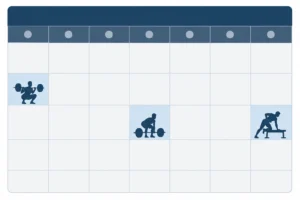
A gym workout plan doesn’t need five days a week to work, and pretending it does is the single biggest reason busy founders quit within a month. A three-day full-body split, run on non-consecutive days like Monday, Wednesday, and Friday, hits every major muscle group with enough frequency to drive progress while leaving four full days for recovery, travel, and the unpredictable schedule a Series A company demands.
Day one of a founder-friendly gym workout plan centers on a squat pattern, a horizontal push like a bench press, and a horizontal pull like a barbell or dumbbell row, followed by a short core finisher. Day two centers on a hinge pattern like a deadlift or Romanian deadlift, a vertical push like an overhead press, and a vertical pull like a pull-up or lat pulldown. Day three repeats a lighter version of day one’s pattern with different rep ranges, since novice and intermediate lifters recover fast enough to hit each movement pattern twice a week without overtraining.
Each session should run 45 to 60 minutes: five compound movements, three to four sets each, in the six-to-twelve rep range that most strength research identifies as the sweet spot for building both size and strength simultaneously. A founder pressed for time cuts rest periods to 90 seconds between sets rather than cutting exercises, since exercise selection drives the actual adaptation and rest periods mainly affect session length.
Progressive overload is the one non-negotiable rule inside any gym workout plan that actually works. Add 2.5 to 5 pounds to the bar, or one additional rep, every session where the previous session’s reps felt manageable. A founder who logs this in a phone note for sixty seconds after each session builds a data trail that shows exactly when a plateau starts, the same way they’d track a KPI dashboard for the business.
Warm-up and mobility work deserve five minutes, not zero and not thirty. A founder skipping warm-ups entirely raises injury risk on heavy compound lifts, while a founder spending thirty minutes on mobility before every session is stealing time from the actual training stimulus. Five minutes of dynamic movement — leg swings, band pull-aparts, bodyweight squats — prepares the joints without eating into the session budget.
Tracking and Adjusting: Treating a Gym Workout Plan Like a Product Metric
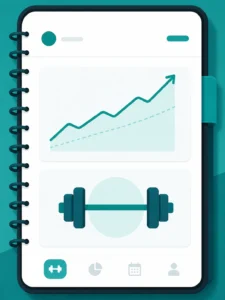
A founder who wouldn’t ship a feature without tracking usage data shouldn’t run a gym workout plan without tracking the equivalent: weight on the bar, reps completed, and body weight measured weekly under the same conditions. This isn’t about vanity numbers — it’s about knowing whether the current gym workout plan is producing adaptation or whether it needs a variable changed.
Set a four-week review cycle, the same cadence many Series A teams already use for sprint retros. At the end of four weeks, compare the current numbers on each main lift to the numbers from week one. Consistent upward movement means the current gym workout plan is working and needs no change beyond adding weight. A stalled number on a specific lift for two consecutive sessions signals a need to adjust rep range, add an accessory movement, or check recovery factors like sleep and protein intake before assuming the entire plan needs a rebuild.
Nutrition sits inside this same tracking discipline, though it doesn’t require obsessive calorie counting to matter. A founder aiming to build strength and muscle needs adequate protein intake — research from sports nutrition bodies like the International Society of Sports Nutrition points to roughly 0.7 to 1 gram of protein per pound of body weight as a general target range for people training for muscle and strength — and consistent sleep, since strength gains consolidate during recovery, not during the session itself. A gym workout plan without attention to these two factors underperforms regardless of how well-designed the lifting program looks on paper.
Recovery days matter as much as training days inside this tracking framework. A founder who trains through visible fatigue, elevated resting heart rate, or declining performance on the bar isn’t showing discipline — they’re sabotaging the next several sessions. A gym workout plan built with two full rest days between the heaviest training days respects the biological reality that muscles grow during rest, not during the set itself.
A structured gym workout plan turns physical training into a system a founder can actually sustain instead of a guilt-driven habit that collapses under the first hard sprint. Build the three-day structure, track the numbers like a product metric, and let the compounding results speak for themselves.
Written by Choweats.com
Resources
- “the National Strength and Conditioning Association”https://www.nsca.com/
- “the ISSN’s position stand on protein intake”https://pmc.ncbi.nlm.nih.gov/articles/PMC5477153/
- “peer-reviewed hypertrophy and strength research”https://pmc.ncbi.nlm.nih.gov/?term=Schoenfeld+B+hypertrophy+resistance+training