
Yoga for Beginners: The Highest-ROI 20 Minutes on a Founder’s Calendar
A founder who dismisses yoga for beginners as a wellness fad is skipping the one practice with direct, measurable effects on the two things a Series A company actually runs on: the founder’s decision quality and their ability to stay in the seat for the next eighteen months.
Why Yoga for Beginners Fits a Founder’s Nervous System Better Than Another Workout

Series A founders already live in a chronic stress state — fundraising follow-ups, board prep, and a product roadmap that never sits still. Cardio and lifting sessions add physical stress on top of that baseline, which builds strength and endurance but doesn’t directly train the nervous system to downshift out of fight-or-flight mode. Yoga for beginners does exactly that: slow, controlled breathing paired with sustained postures activates the parasympathetic nervous system, the branch responsible for lowering heart rate and cortisol after a stress spike.
Harvard Medical School’s own patient education material on yoga describes this mechanism directly, noting that the combination of physical postures, breath control, and meditation in yoga practice has been linked to reduced stress hormone levels and improved heart rate variability in controlled studies. Heart rate variability matters to a founder in a very practical way: research summarized by the American Psychological Association links higher heart rate variability to better executive function under pressure, meaning a founder walking into a hard board conversation with a regulated nervous system makes clearer calls than one running on adrenaline alone.
Yoga for beginners also solves a scheduling problem that gym-based training doesn’t. A basic beginner sequence needs no equipment, no drive time, and no more than 20 minutes on a hotel room floor before a 7 a.m. investor call. A founder traveling for fundraising doesn’t lose the practice the way they lose a normal gym routine, because a beginner yoga flow travels in a phone app and unrolls on any flat surface.
The injury-risk profile also favors a founder new to structured movement. Someone who hasn’t trained consistently in years and jumps straight into heavy barbell work carries real injury risk without proper coaching. Yoga for beginners builds baseline mobility, joint stability, and body awareness first, creating a safer on-ramp into any other physical training a founder adds later.
The ROI Data: What Yoga for Beginners Actually Changes in Founder Performance

Founders trust numbers, so the case for yoga for beginners needs to rest on measurable outcomes, not the aesthetic of a studio class. A 2015 review published in Frontiers in Psychiatry, analyzing multiple controlled trials, found consistent reductions in self-reported stress and anxiety symptoms among yoga practitioners compared to non-practicing control groups, with several trials also reporting improved sleep quality — a direct lever on the next-day decision-making every founder relies on.
Sleep is the underrated variable here. The Sleep Foundation cites research showing yoga practice, particularly evening sequences focused on slow breathing and gentle stretching, correlates with faster sleep onset and fewer nighttime awakenings in adults reporting stress-related sleep disruption. A founder losing 45 minutes of sleep to racing thoughts after a hard investor call isn’t just tired the next day — they’re running board meetings and product decisions on a measurably worse cognitive baseline, and yoga for beginners directly targets the physiological loop causing that sleep disruption.
Real example from the startup world: Marc Benioff has spoken publicly about meditation and mindfulness practice — closely related to the breathing techniques central to yoga for beginners — as part of his personal operating system at Salesforce, crediting it with helping him manage the stress of running a large company through volatile periods. The specific mechanism he describes matches what yoga for beginners trains from day one: slowing the breath to interrupt a stress spiral before it drives a rushed decision.
Cost also favors yoga for beginners over almost every alternative wellness intervention a founder might consider. A beginner sequence costs nothing beyond a mat and 20 minutes, compared to therapy, executive coaching, or a dedicated trainer, all of which carry real value but also real dollar cost and scheduling friction. Yoga for beginners isn’t a replacement for those tools when a founder needs them — it’s a zero-friction daily practice that reduces how often a founder hits the point of needing more intensive intervention.
A Realistic Beginner Sequence a Founder Can Actually Sustain
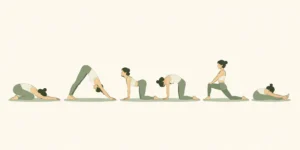
Yoga for beginners fails most founders not because the practice doesn’t work, but because the onboarding is wrong — a 90-minute studio class with Sanskrit pose names and no clear progression feels like a foreign product with no documentation. A founder needs a sequence that works the way a good onboarding flow works: minimal steps, clear instructions, fast time to first result.
Start with five foundational poses, held for five breaths each, in a 15-to-20-minute morning or evening block. Child’s pose opens the lower back and signals the nervous system to slow down, functioning as the natural first and last pose in any beginner sequence. Downward-facing dog stretches the hamstrings and shoulders while building baseline arm and core strength, making it the closest thing yoga for beginners has to a compound movement. Cat-cow, a slow spinal flexion and extension movement, undoes the static sitting posture every founder holds through back-to-back calls. Low lunge opens the hips, which tighten fastest from a desk-bound schedule.
Breath technique matters more than pose precision for a beginner. A founder should focus on slow, even inhales and exhales through the nose, roughly matching a four-count in and a four-count out, rather than worrying about hitting a textbook-perfect pose. Yoga for beginners rewards consistent breath control far more than it rewards flexibility, and flexibility improves naturally with repetition regardless of where a founder starts. Consistency beats intensity for this specific practice. A founder running this five-pose sequence five mornings a week builds more nervous-system regulation over a month than someone doing one 90-minute class every other weekend. Yoga for beginners works through repeated, brief exposure to controlled breathing and gentle movement — the compounding effect looks a lot like the effect of a daily standup versus a monthly all-hands, where frequency drives the actual behavior change more than any single session’s length.
Free, high-quality instruction removes the last barrier. Certified instructors post full beginner sequences on YouTube at no cost, and apps like Down Dog offer structured beginner programs with adjustable session length, letting a founder fit a 10-minute version into a genuinely packed morning without abandoning the practice on a busy week.
Avoiding the Two Mistakes That Make Founders Quit Yoga for Beginners Early
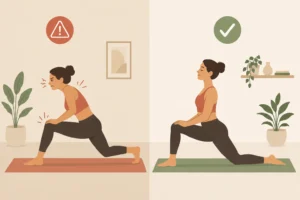
The first mistake is treating yoga for beginners as a competitive activity. A founder used to hitting KPIs applies the same instinct to a yoga class, straining into a deeper stretch than their body is ready for and risking a pulled muscle in the first two weeks. Yoga for beginners isn’t a performance metric — a founder who backs off a stretch the moment it becomes sharp rather than mildly uncomfortable protects the very consistency that makes the practice work.
The second mistake is over-scheduling the practice like a big product launch instead of a small recurring habit. A founder who blocks a full hour for yoga, misses that hour once because of a fundraising fire drill, and then abandons the whole practice out of guilt is applying the wrong mental model. Yoga for beginners survives a missed day far better than it survives an all-or-nothing framing — a 10-minute version on a chaotic day keeps the habit alive better than skipping entirely and restarting from zero a month later.
Founders who track other metrics obsessively should resist the urge to over-quantify this one. Yoga for beginners doesn’t need a spreadsheet or a wearable score to prove its value — the felt difference in a founder’s ability to sit through a tense investor call without their heart rate spiking is the signal, and that signal shows up within two to three weeks of consistent practice, not two to three months.
Yoga for beginners isn’t a wellness trend competing for a founder’s limited time — it’s a 20-minute daily input that measurably improves the nervous-system regulation, sleep quality, and decision-making a Series A company depends on every single day. Roll out the mat before the first Slack notification hits, and let the next board meeting be the proof.
Written by Choweats.com
Resources
- “Harvard Health’s research on yoga and heart health”https://www.health.harvard.edu/heart-health/more-than-a-stretch-how-yoga-can-enhance-heart-health
- “Harvard Health’s coverage of yoga’s mental health effects”https://www.health.harvard.edu/staying-healthy/yoga-for-better-mental-health